


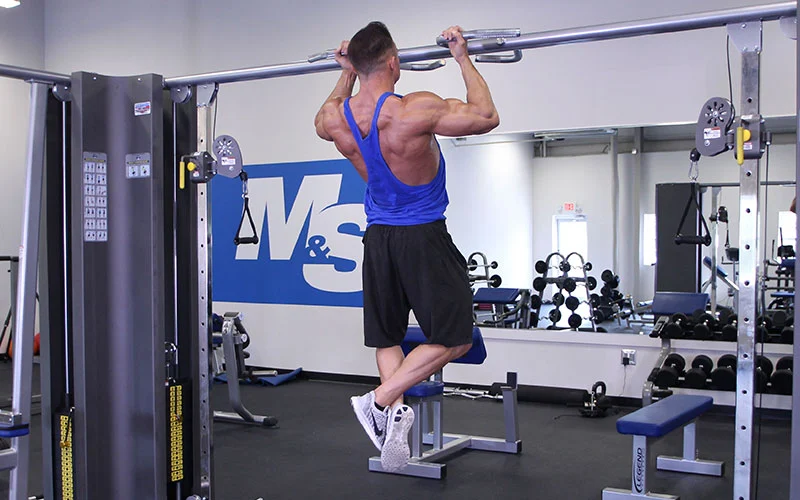
Chin-Up exercise for building upper-body strength and muscle
A chin-up is a challenging but empowering exercise. It’s an engaging move that involves lifting your entire body weight off of the ground. Although it takes some effort, most athletes and fitness enthusiasts can greatly benefit from incorporating chin-ups into their workout routine.
What Is a Chin-Up?
Chin-ups are a type of resistance exercise. Resistance moves are great for building and strengthening your muscles. Sometimes barbells, dumbbells, and other equipment provide added resistance in this type of exercise. But in the case of chin-ups, your body weight is enough to properly activate your muscles.
The only equipment that you need to perform a chin-up is a strong, immobile bar. It needs to be strong enough to support your full weight and secure enough that you feel safe moving on it. Ideally, it should be above your head but still within arm’s reach. You can also adapt to a shorter bar if that’s all that you have on hand.
There are a number of variations to the chin-up. Some of these involve additional equipment. For example, you can try out a pull-up assist machine at your local gym. You can also use a thick band, like a superband, to provide support when you’re just starting out.
What Muscles Does a Chin-Up Work?
Chin-up exercises work a large number of muscles throughout your arms, shoulders, abdomen, and back. Some of the key chin-up muscles worked include:
- Biceps. These are thick upper arm muscles. They’re the muscles that you’re showing off when you flex. They significantly contribute to your arm strength.
- Posterior deltoids. These are shoulder muscles that help your arm move backward. They’re connected to your shoulder blades and help with activities like pitching baseballs.
- Teres major. This muscle is located near your shoulder. It helps your arm move and rotate.
- Latissimus dorsi. This is a broad, flat muscle that spans your lower back. It supports your arm and spinal movements.
- Deep spinal stabilizers. This includes your transverse abdominus and thoracolumbar fascia. These muscles contribute a lot to your posture. By strengthening them, you strengthen the support for your spine.
How to Do a Chin-Up

It’s hard to do a chin-up perfectly. You need to make sure to pay special attention to your posture and motions throughout the exercise. Otherwise, the exercise won’t be as effective and you risk injuring yourself.
The steps to a chin-up are as follows:
- Stand with your arms shoulder-width apart and reach up to grab the overhead bar. Make sure to use an underhand grip — so your palms face toward you.
- Brace your abdominal muscles to create tension throughout your body — this increases your stability as you move.
- Pull yourself up from your stationary position until your chin is above the bar. Your legs should remain as still as possible and your neck should be in a neutral position, with your head facing forward.
- Pause for a moment at the top.
- Then slowly lower yourself back down. Force yourself to move slowly during this portion to maximize your gains from this exercise.
You may only be able to do one or two chin-ups when you’re first starting out. You should work up to an initial goal of three complete, well-controlled chin-ups. Then you can progressively add more as your strength improves over time. Beginners can do more if they’re using a machine for assistance.
For the most part, you want to fit in two days of resistance training each week. But don’t do these workouts two days in a row. Give your body time to rest and build muscle between resistance sessions.
Chin-Up Adaptations
Many people need to work their way up to a full-blown chin-up. Particular variations on the exercise make this easier to accomplish. These variations include chin-ups that:
- Use racks or squat cages. These types of gym equipment allow you to create a shorter, stable chin-up bar. With a shorter bar, you can keep your feet on the ground. Then only lift part of your body weight up over the bar while your toes remain on the ground. This way you can work on your form while building up to your entire body weight.
- Use stretchy bands. You can use a large elastic band — like a superband — to help support some of your weight during chin-ups. You place the band around the bar then insert your knees. The band should rest around your ankles when you’re doing chin-ups.
- Incorporate momentum for high-intensity training. Some high-intensity programs actually want you to do chin-ups as quickly as possible. Unlike a regular chin-up, the focus of these exercises isn’t on building muscle strength. But they do have their own benefits. These chin-ups can be dangerous if you don’t know what you’re doing. Don’t try high-intensity chin-ups without guidance from a qualified professional.
Benefits of Chin-Ups
There are a number of benefits to strengthening exercises like chin-ups. Examples of chin-up benefits include:
- Increases in muscle strength and definition — like other resistance exercises, chin-ups are great for increasing your strength
- Improvements in grip strength
- Improvements to your posture
- A lowered chance of upper back pain and shoulder injury
- A decreased risk for heart problems, obesity, and other health issues
Chin-Up Mistakes to Avoid
The most common mistake people make when doing chin-ups is that they don’t complete the full movement. If you’re tired, you may find yourself trying to cheat by jumping up to start the chin-up or not coming down far enough when you’re lowering your body. These mistakes make the exercise much less effective than it could be.
Other mistakes include:
- Using too much momentum — this can weaken your grip and increase your risk of injury
- Forgetting to brace your core
- Letting your chin jut out — it should be tucked in toward your neck and your neck should be aligned with your spine
- Trying to curl your knees into your torso — this isn’t the correct posture for a chin-up
Credit: Alyssa Anderson, WebMD.com


